Airbag Fuse Safeguards Airbag Deployment System Electrical Circuits In Modern Vehicles
News 2025-11-17
Airbag fuse fundamentals in safety electronics
In modern automotive safety systems, the airbag fuse acts as a dedicated protection device for the airbag deployment circuit. It is engineered to isolate the inflator modules, control unit, and trigger circuitry from overcurrent, short circuits, and wiring faults. By interrupting abnormal current before it reaches the squib or inflator igniter, the fuse prevents unintended deployment and protects sensitive semiconductor devices in the airbag control unit. Proper fuse selection supports compliance with ISO 26262 functional safety requirements and aligns the electrical design of the restraint system with OEM reliability and warranty targets.
Circuit protection role and working principle
The airbag fuse is typically placed between the vehicle power supply and the airbag electronic control unit, as well as in branch lines feeding individual inflators or pretensioners. Under normal operating conditions, the fuse carries low current levels consumed by diagnostics, self‑test functions, and readiness monitoring. When a fault causes excessive current, the precisely calibrated fusible element heats rapidly and melts, opening the circuit within milliseconds. This controlled disconnection prevents damage to MOSFET drivers, prevents wiring harness overheating, and maintains predictable deployment characteristics by ensuring that only a valid control signal, not a fault current, can reach the igniter.
Key performance advantages in airbag deployment systems
Airbag fuses used in deployment circuits emphasize fast-acting behavior, tight current tolerance, and high breaking capacity. Fast blow response enables protection against sudden shorts caused by chafed cables or connector failures near the inflator. Current rating precision supports consistent coordination with airbag control algorithms and firing capacitors, maintaining accurate timing between crash detection and squib activation. High interrupt ratings allow the fuse to safely open even under the high transient currents present in modern 12 V and 48 V vehicle electrical architectures. Low internal resistance minimizes voltage drop, ensuring that sufficient power reaches the inflator at the moment of deployment.
Application scenarios in modern automotive platforms
In passenger cars, SUVs, and commercial vehicles, airbag fuses protect driver and passenger airbags, side curtain airbags, knee airbags, and seatbelt pretensioners. Each module may be protected by individual fuses or grouped fuse blocks depending on system architecture. Electric vehicles and hybrids place additional stress on the electrical system due to higher transient loads and dense wiring, making dedicated airbag fusing crucial for electromagnetic compatibility and thermal management. In fleets and autonomous test vehicles, engineers rely on traceable, automotive‑grade fuses to ensure consistent performance during repeated crash tests, data logging, and long‑term durability validation.
Selection criteria, standards, and integration best practices
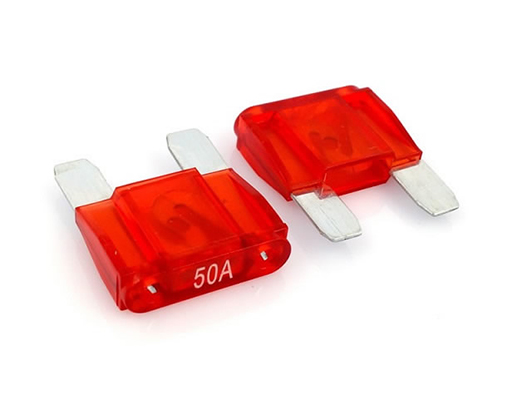
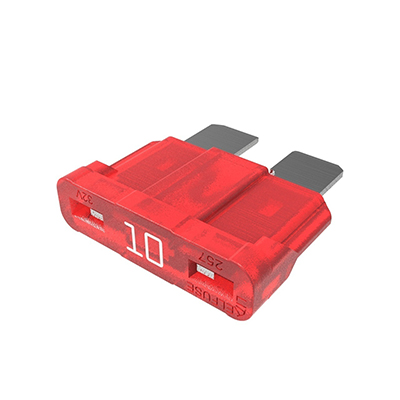
When engineers choose an airbag fuse, they evaluate rated current, voltage, time‑current curves, operating temperature range, vibration resistance, and package style. Surface‑mount fuses support compact airbag ECUs placed near sensor clusters, while blade or cartridge fuses are often used in power distribution boxes. Devices must comply with AEC‑Q200 or equivalent automotive qualification and meet OEM‑specific endurance and surge tests. Proper coordination between the fuse and firing circuit ensures that crash‑event current surges allocated for squib activation are not interrupted, yet any unintended continuous overcurrent is safely cleared. Thoughtful PCB layout, controlled impedance traces, and secure connectors further enhance system robustness and support long‑term occupant protection performance.
1. What happens if an airbag fuse is blown?
A blown airbag fuse disables power to part or all of the airbag system, preventing deployment and typically triggering a warning light on the dashboard until the root cause is diagnosed and the fuse is replaced.
2. Can a standard automotive fuse be used in an airbag circuit?
Using a generic fuse is not recommended; airbag circuits require automotive‑grade fuses designed for precise time‑current characteristics, high reliability, and compliance with safety standards.
3. How often should the airbag fuse be inspected?
The fuse does not require routine replacement, but it should be checked whenever the airbag warning lamp is illuminated or after any electrical repair involving the restraint system.