Durable Thermal Fuse Enhances Safety in Modern Automotive Electrical Architecture
News 2025-11-27
Durable thermal fuses play a decisive role in safeguarding modern automotive electrical systems, where high current loads, compact packaging, and increasing electronics density raise the risk of overheating. By providing temperature‑dependent, one‑time cutoff protection, these components prevent wire harness damage, module failure, and fire hazards under abnormal thermal conditions. In contrast to conventional fuses that respond primarily to current, the thermal fuse reacts to excess heat at precisely engineered thresholds, disconnecting the circuit before insulation materials, connectors, or semiconductor devices reach destructive temperatures.
Key Operating Principles and Construction
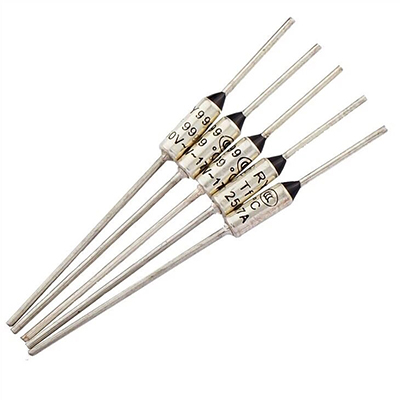
A durable automotive thermal fuse uses a calibrated organic pellet or alloy element that changes state when a predefined temperature is reached. During normal operation, internal spring contacts remain engaged, allowing current to pass with very low resistance, minimizing insertion loss in sensitive electronic subsystems. When local temperature exceeds the rated trip point, the fusible element melts or collapses, releasing the spring and permanently opening the circuit. Robust lead construction, high‑temperature housings, and vibration‑resistant terminations are engineered to withstand harsh under‑hood environments, including wide thermal cycling, humidity, and mechanical shock.
Automotive Application Scenarios
Durable thermal fuses are widely deployed in cabin HVAC blowers, seat heaters, window defoggers, fuel pump modules, DC‑DC converters, onboard chargers, and battery management electronics. In seat and steering wheel heaters, they stop power delivery when a controller fault or relay sticking causes abnormal heat buildup in resistive elements. Within battery pack junction boxes and power distribution units, they protect harness branches and connector interfaces from localized hot spots arising from aging contacts or unexpected load conditions. Integration close to the heat source allows accurate temperature sensing where traditional fuses or breakers cannot respond adequately.
Performance Advantages in Safety and Reliability
Compared with overcurrent fuses and resettable polymer protectors, thermal fuses provide a sharply defined trip temperature, which is crucial when component lifetime is strongly temperature‑dependent. Their compact size supports high‑density module design, while low impedance helps maintain energy efficiency in 12 V, 24 V, and high‑voltage architectures. Automotive‑grade thermal fuses are tested for long‑term stability, electrical endurance, and resistance to contaminant ingress, ensuring consistent activation after years of service. The permanent open state after operation creates a clear, fail‑safe condition that encourages timely fault investigation rather than unnoticed automatic reset.
Design Integration and Selection Considerations
Engineers select a thermal fuse by matching its rated opening temperature and current capacity to the worst‑case operating profile of the target circuit. Placement is usually as close as possible to critical heat sources such as power MOSFETs, transformer windings, heater mats, or motor windings. Proper thermal coupling, creepage distance, and coordination with electronic control units, relays, and overcurrent devices are essential to avoid nuisance activation while guaranteeing protection under real fault scenarios. Using components that comply with automotive standards, such as AEC‑Q200‑type qualification, supports safe use in high‑volume vehicle platforms and supports long‑term warranty expectations.
1What distinguishes a thermal fuse in automotive systems?
A thermal fuse responds to temperature, not just current, opening the circuit permanently when a defined trip temperature is reached, which stops overheating in components and wiring even if current remains within normal limits.
2Where is a durable thermal fuse typically installed in a car?
It is commonly installed in seat heaters, blower motors, battery modules, DC‑DC converters, onboard chargers, and power distribution units, located physically close to potential hot spots to sense real component temperature.
3How should engineers choose an appropriate thermal fuse rating?
They should analyze normal operating temperatures, fault scenarios, and maximum current, then select a fuse whose opening temperature sits above the highest normal condition yet below any level that could damage insulation, connectors, or semiconductor devices.