Quick-Response Thermal Fuse Enhances Circuit Safety Under Excessive Heat Conditions
News 2025-11-27
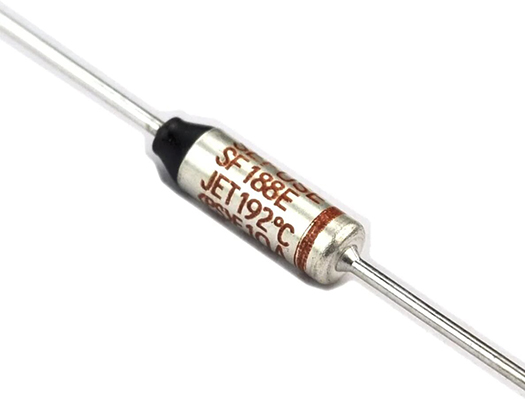
Quick-response thermal fuses have become a key protection element in modern electronic systems where compact layouts and rising power densities raise the risk of localized overheating. Unlike resettable devices, a thermal fuse provides a permanent, one‑time interruption of current once a defined temperature threshold is reached. This irreversible action safeguards sensitive semiconductor components, wiring harnesses, batteries, and plastic enclosures from damage or ignition when abnormal heat builds up due to faults, blocked airflow, or mechanical failure.
Operating Principle and Construction
A quick-response thermal fuse contains a temperature-sensitive organic pellet, alloy, or solder joint that mechanically releases spring contacts when a calibrated melting point is exceeded. The device is normally closed and carries rated current with minimal resistance and low self‑heating. When ambient or contact temperature rises to the specified cut‑off level, the fusible element changes state and the circuit opens permanently. Precision manufacturing controls pellet composition, contact pressure, and encapsulation so that the opening temperature window remains tight, enabling predictable performance across production batches and long-term service.
Key Performance Advantages
Compared with conventional overcurrent fuses or electronic protection ICs, quick-response thermal fuses react directly to heat rather than current alone. This allows protection against blocked fan operation, stuck motors, abnormal ambient temperature, or thermal runaway conditions where current may remain within specification. Fast thermal coupling between the fuse body and the heat source supports short response times and limits peak temperature at critical components. Low series resistance, compact axial or radial packages, and UL/TÜV safety approvals make these devices easy to integrate while maintaining high power efficiency and compliance with international safety standards.
Application Scenarios in Power and Consumer Electronics
Quick-response thermal fuses are widely used in SMPS power supplies, LED drivers, adapters, battery packs, EV charging accessories, and industrial controllers. In transformers and coils, they sense core or winding temperature and disconnect the primary circuit before insulation is compromised. In household appliances such as coffee makers, hair dryers, rice cookers, and space heaters, they provide an independent safety layer beyond thermostats that may fail in a welded‑closed condition. In lithium‑ion battery assemblies, a thermal fuse mounted close to the cell array mitigates risk during overcharging or internal short events, supporting compliance with stringent transportation and safety regulations.
Selection, Integration, and Design Considerations
Engineers selecting a thermal fuse typically define the required cut‑off temperature, operating temperature margin, rated voltage, and steady‑state current. The fuse must be positioned where it accurately tracks the hottest point in the system under worst‑case conditions. Good thermal coupling through direct contact or thermally conductive adhesives significantly improves response speed. Designers should also evaluate surge current capability, mechanical mounting options, and compatibility with automated soldering processes. To maintain long‑term stability, it is important that the normal operating temperature stays sufficiently below the opening temperature, preventing premature aging or nuisance operation.
FAQs on Quick-Response Thermal Fuses
1. What distinguishes a thermal fuse from a thermal switch?
A thermal fuse opens the circuit once and remains permanently open, requiring replacement, while a thermal switch or thermostat cycles between open and closed states as temperature fluctuates.
22. How is the opening temperature of a thermal fuse chosen?
Engineers select a rating that sits above the maximum normal operating temperature yet below the temperature at which insulation, plastics, or cells could be damaged, leaving adequate safety margin.
33. Can a thermal fuse replace electronic overcurrent protection?
A thermal fuse complements, but does not fully replace, overcurrent protection; it focuses on temperature-based hazards, while electronic or conventional fuses address short circuits and overload currents.