Rapid-Activation Thermal Fuse Enhances Overheat Protection in Power Electronics
News 2025-11-27
Rapid-activation thermal fuses play a decisive role in preventing catastrophic failures in consumer, industrial, and automotive electronics. By interrupting current flow within milliseconds of reaching a preset temperature, these one-shot devices protect transformers, battery packs, switching power supplies, LED drivers, chargers, and motor windings from thermal runaway. Their compact size and predictable opening characteristics make them integral to safety-compliant designs that must meet UL, IEC, and automotive standards while keeping PCB space and cost under control.
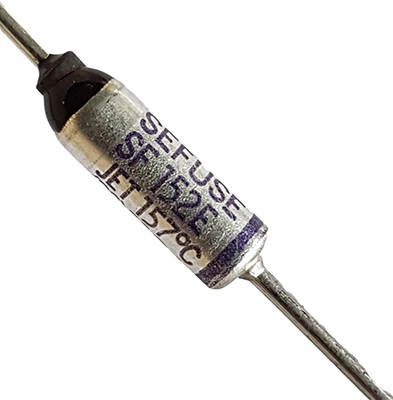
Operating Principle and Key Characteristics
A rapid-activation thermal fuse contains a temperature-sensitive pellet, alloy element, or organic material that changes state at a calibrated melting or decomposition point. When the surrounding temperature exceeds this rated value due to overload or abnormal conditions, the internal structure mechanically separates the conductive path, driving the device into a permanent open circuit. Unlike resettable protectors, the thermal fuse does not reclose, ensuring a clear fail-safe indication. Critical parameters include opening temperature, holding temperature, rated current, interrupting capacity, insulation resistance, and thermal response time, all of which must be selected to match the host system’s derating profile and expected ambient environment.
Application Scenarios in Modern Electronics
Designers deploy rapid-activation thermal fuses in a wide range of applications where overheating can ignite flammable materials or damage expensive components. In lithium-ion battery packs for tools, e-bikes, and energy storage, the fuse is typically placed in series with the pack output or individual cell strings to interrupt current if internal cell temperature rises beyond safe limits. In AC adapters and high-density switch-mode power supplies, a thermal fuse embedded near the transformer or primary switching devices protects against blocked airflow, component failure, or control-loop faults. Home appliances, HVAC control boards, lighting ballasts, and EV on-board chargers also rely on thermal fuses to meet safety regulations and reduce the risk of field failures and recalls.
Performance Advantages and Design Benefits
Compared with standard overcurrent fuses or resettable PTC devices, rapid-activation thermal fuses are triggered by temperature rather than purely by current magnitude. This allows accurate protection against subtle fault modes such as partial short circuits, mechanical obstruction of motors, or poor thermal coupling to heatsinks, where current may remain within nominal limits while localized hotspots form. The predictable opening temperature simplifies thermal modeling and compliance documentation. Because the fuse has low resistance in the normal state, it introduces minimal power loss and heat generation, which is crucial in compact, high-efficiency designs. Permanent disconnection after activation reduces the chance of repetitive stress on surrounding components and provides clear evidence of an overtemperature event for service personnel.
Selection, Integration, and Safety Compliance
Effective use of a rapid-activation thermal fuse requires careful placement and thermal coupling to the component or region at highest risk. Engineers typically mount the device in direct contact with transformer windings, MOSFET cases, or battery cells using high-thermal-conductivity sleeving, adhesive, or clamps. Selection must consider worst-case ambient temperature, internal temperature rise, and manufacturing tolerances so that the rated functioning temperature is above the maximum normal operating point yet low enough to prevent insulation breakdown or venting. Compatibility with standards such as UL60691 and IEC60691 is important for safety certification and market access. Short-circuit testing, surge evaluation, and end-of-line inspection help confirm that the fuse will interrupt fault current without explosion or excessive arcing.
1What differentiates a thermal fuse from a standard current fuse?
A thermal fuse responds to temperature at the installation point, not just to overcurrent. It opens when a defined temperature threshold is reached, even if current remains within normal limits.
2Can a rapid-activation thermal fuse be reset after it opens?
No. Once the internal element operates, the thermal fuse becomes permanently open and must be replaced to restore circuit continuity.
3Where is the best location to install a thermal fuse in power supplies?
The fuse should be thermally coupled to the hottest and most failure-prone components, typically transformer windings, power semiconductors, or densely populated areas where heat concentration is highest.