Safety-Certified Thermal Fuse Enhances Battery Pack Protection in Modern Vehicles
News 2025-11-27
Safety-Certified Thermal Fuse Provides Critical Protection for Car Batteries
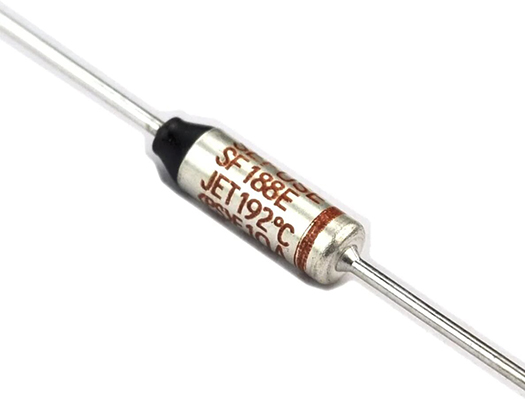
Role of Thermal Fuses in Automotive Battery Packs
Thermal fuses designed for traction batteries interrupt current when temperature exceeds a calibrated trip point, preventing cell venting or thermal runaway. In high-energy lithium-ion packs, dense cell arrays, compact busbars, and fast-charging currents generate heat that can quickly move beyond safe limits. A safety-certified thermal fuse, tested to automotive and IEC safety standards, provides a defined cutoff path that complements electronic protection such as BMS-controlled MOSFETs or contactors. Where electronic control may fail due to software errors, sensor faults, or wiring damage, the fuse acts as a passive, irreversible safeguard, preserving pack integrity and meeting OEM functional safety targets.
Key Performance Features and Safety Certifications
Automotive-grade thermal fuses for car batteries must demonstrate precise opening temperature, high interrupt rating, low initial resistance, and long-term stability under vibration and thermal cycling. Devices are typically qualified to AEC-Q200 and carry UL and TÜV certifications verifying breaking capacity and safety performance under abnormal conditions. Fast response to overtemperature is balanced against avoidance of nuisance tripping during high-current acceleration or rapid DC fast charging. Stable contact resistance minimizes energy loss and heat generation at normal load. Encapsulation and lead structures are engineered to survive under-hood environments where exposure to fluids, mechanical shock, and wide ambient temperature swings is routine.
Application Scenarios in Electric and Hybrid Vehicles
The primary application is in lithium-ion battery modules used in BEV, HEV, and PHEV platforms, where the thermal fuse is placed in series with cell strings or submodules. It may be installed close to heat-critical zones such as high-current junctions, terminal studs, or near cells with historically higher temperature gradients. In 12 V and 48 V auxiliary battery systems, compact thermal fuses prevent overheating during fault conditions in start-stop systems, DC-DC converters, and high-power infotainment loads. They are also suitable for battery junction boxes, on-board chargers, and energy storage units in micro-hybrid architectures that demand high cycle life and strong protection against internal short circuits.
Design Considerations and Integration Benefits
When selecting a thermal fuse, automotive engineers evaluate nominal current, maximum operating voltage, target trip temperature, and mounting method, such as radial leaded, surface-mount, or bolt-down designs. Proper thermal coupling to the monitored location is crucial, often achieved through direct contact with busbars or cell tabs using clips, clamps, or thermally conductive tape. Correct derating ensures that the fuse remains stable across the full automotive temperature range while still acting quickly in fault scenarios. The integration of a safety-certified thermal fuse helps OEMs and Tier-1 suppliers meet ISO 26262 safety goals, reduce risk of field failures, and simplify compliance documentation for regulators and customers.
FAQ: Thermal Fuses in Car Battery Protection
1How does a thermal fuse differ from a standard current fuse?
A thermal fuse responds primarily to excessive temperature rather than only current level, providing protection against overheating due to internal cell faults, poor contact resistance, or cooling system failure.
2Where is the thermal fuse typically installed in a battery pack?
It is usually installed in series with cell groups or busbars, physically located close to the hottest potential spots so that it senses real thermal conditions within the module or pack.
3Can a blown thermal fuse be reset or reused?
No, a thermal fuse is a one-time protective device; once it opens, the component must be replaced and the root cause of overheating must be investigated before the battery pack is returned to service.