Weather-Resistant Design Thermal Fuse Ensures Stable Protection Across Harsh Environments
News 2025-11-27
Weather-resilient circuit protection has become a core requirement in modern electronics, from outdoor telecom cabinets to smart home appliances exposed to moisture and dust. A weather-resistant-design thermal fuse provides predictable cut-off behavior when abnormal temperature rises occur, safeguarding transformers, motors, power supplies, EV charging modules, and LED drivers. By integrating temperature-sensitive alloy elements into a sealed construction, the fuse interrupts overcurrent situations triggered by thermal overload rather than just instantaneous short-circuit events.
Robust Structure for All-Weather Operation
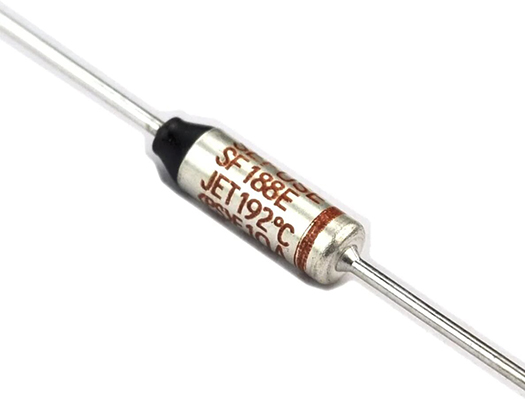
A weather-resistant thermal fuse is built around a hermetically sealed housing that prevents moisture ingress, dust contamination, and corrosion of internal components. Metal or high-temperature resin cases are combined with precision glass or ceramic insulation to maintain dielectric strength under extreme humidity, salt fog, or temperature cycling. The temperature-sensing pellet and fusible alloy are calibrated to a defined opening temperature, typically ranging from 70°C to 240°C, enabling tight control of protection thresholds. This structure maintains consistent response characteristics whether the device is installed in arid outdoor enclosures, coastal installations, or indoor environments subjected to steam or condensation.
Key Performance Advantages and Safety Benefits
The primary advantage of this thermal fuse type is stable opening performance across a broad ambient temperature range, minimizing nuisance trips while still reacting rapidly to genuine overheating. Low internal resistance reduces self-heating losses and supports higher operating currents in compact circuits. Compliance with standards such as IEC 60691 and UL 60691, along with glow-wire and flammability requirements, reinforces suitability for safety-critical equipment. Fast, irreversible cut-off prevents insulation damage, winding failure, and fire hazards in power converters, chargers, and motor windings. The fuse’s compact footprint and axial or radial lead configurations simplify integration into high-density PCB layouts and potted assemblies.
Application Scenarios Across Diverse Environments
Outdoor power distribution units, photovoltaic junction boxes, and communication base stations rely on weather-resistant thermal fuses to handle broad diurnal temperature swings and continuous solar radiation. In HVAC systems, pumps, and fan motors, the fuse is often embedded in the winding or mounted on heat sinks to detect localized hotspots caused by blocked airflow or mechanical locking. Household appliances such as electric heaters, coffee machines, dryers, and induction cookers deploy these fuses around heating elements to enforce a final level of protection beyond electronic temperature control. In LED lighting drivers and street lamps, the device helps prevent overheating caused by degraded thermal interfaces or airflow restrictions in sealed luminaires.
Design-In Considerations and Selection Parameters
Engineers selecting a weather-resistant thermal fuse must evaluate rated current, opening temperature, maximum ambient temperature, and expected thermal profile of the target system. Proper mounting is critical: close thermal coupling to the hottest component ensures accurate sensing of abnormal conditions. Sufficient spacing, creepage, and clearance distances should be maintained to match system insulation coordination, especially in high-voltage applications. Designers should review derating curves that account for ambient temperature and enclosure type, ensuring safe operation over the full service life. Using high-quality, weather-resistant encapsulants and secure crimping or solder methods preserves long-term contact stability under vibration and repeated temperature cycling.
FAQ on Weather-Resistant Thermal Fuses
1. How does a weather-resistant thermal fuse differ from a standard fuse?
A standard fuse typically reacts only to overcurrent, while a weather-resistant thermal fuse responds to temperature rise and is packaged to resist humidity, dust, and corrosion, maintaining consistent behavior in harsh environments.
2. Where is this type of thermal fuse most commonly used?
It is widely adopted in outdoor power equipment, LED street lighting, EV chargers, industrial control cabinets, and household appliances that operate in damp, dusty, or thermally stressed conditions.
3. Can a thermal fuse be reset after it opens?
No. Once a thermal fuse opens, it must be replaced, which ensures that any serious overheating event results in permanent circuit interruption and prevents unsafe automatic restart.