Power Distribution Variations Of Fuse Box In Modern Vehicle Electrical Architecture
News 2025-12-30
Modern vehicles depend on increasingly complex electrical architectures, and fuse box design now plays a strategic role in power distribution, safety, and diagnostics. Instead of a single under‑hood block, contemporary platforms may integrate multiple fuse and relay centers to support high current loads, advanced driver assistance systems, infotainment, and electrified powertrains. These variations in layout, protection strategy, and component selection directly influence performance, serviceability, and scalability across model ranges.
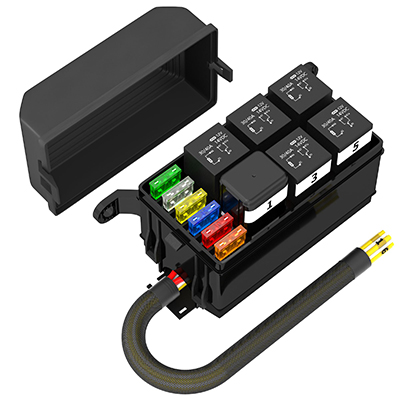
Centralized vs. Distributed Fuse Box Layouts
Centralized fuse boxes, typically located in the engine compartment, simplify wiring and assembly but can create dense harness routing and higher thermal stress. Distributed designs divide protection across front, cabin, and rear units, shortening cable runs and reducing voltage drop to high‑demand loads such as electric power steering, HVAC blowers, and rear defoggers. This approach supports modular vehicle platforms where trim levels and regional options require flexible power distribution schemes. Engineers balance packaging constraints, fault isolation, and assembly cost when choosing the degree of distribution.
Performance and Protection Characteristics
Fuse box variations also reflect different protection philosophies. High‑current circuits often rely on bolt‑down fuses or fusible links combined with solid‑state relays to manage peak loads and transient conditions. Low‑current branches use blade fuses, sometimes integrated into multilayer printed circuit boards that support busbars and control electronics. Proper coordination between fuse ratings, wire gauges, and load profiles enhances short‑circuit protection while minimizing nuisance blows during inrush events such as motor startup. Thermal management, contact resistance, and environmental sealing are critical performance factors in high‑density modules.
Application Scenarios in Modern Vehicle Systems
Different vehicle categories apply distinct fuse box strategies. Battery electric vehicles and plug‑in hybrids require dedicated protection for high‑voltage junction boxes, DC‑DC converters, onboard chargers, and battery heaters, alongside traditional low‑voltage distribution. Commercial vans may use auxiliary fuse centers to support telematics, refrigeration units, and aftermarket bodies. Premium passenger cars integrate smart junction boxes that communicate diagnostic data over CAN or Ethernet, enabling remote monitoring of blown fuses and load status. These scenarios highlight how tailored power distribution supports performance, uptime, and integration of new electronic functions.
Future Trends and Design Optimization
The industry is moving toward semi‑conductive and fully electronic power distribution units that combine solid‑state switches, current sensing, and software‑defined load control. While mechanical blade fuses remain dominant due to cost and simplicity, hybrid fuse boxes now embed intelligent drivers and microcontrollers for optimized power allocation and predictive maintenance. From an SEO perspective, topics such as automotive fuse box performance, smart power distribution, and EV fuse protection will remain central to design discussions as vehicles add more sensors, actuators, and safety‑critical electronics.
1. How do distributed fuse boxes benefit EVs?
They shorten high‑current cable runs, reduce losses, and allow dedicated protection near the battery pack, inverter, and charging interfaces.
2. Why are solid‑state devices entering fuse box designs?
They enable precise current limiting, faster fault isolation, and remote diagnostic capabilities that mechanical fuses cannot provide.
3. Where are fuse boxes typically located in modern vehicles?
Common locations include the engine bay, driver side dashboard area, and rear luggage compartment or under‑seat zones, depending on platform layout.