Choosing Inline Fuse Holder vs Fuse Block: Assessing Performance and Application
News 2026-01-12
Modern wiring systems rely on robust fuse protection to safeguard electrical circuits against overloads and short circuits. Two common solutions—inline fuse holders and fuse blocks—offer distinct form factors and installation methods that affect maintenance, safety, and overall performance. Inline holders mount directly in series with a single conductor, providing a compact footprint ideal for one-off runs. Fuse blocks create a centralized housing for multiple fuses, supporting clear circuit identification and simplified expansion. Choosing the appropriate option involves evaluating spatial restrictions, service access requirements, and the operating environment of the electrical assembly.
Design and Installation Considerations
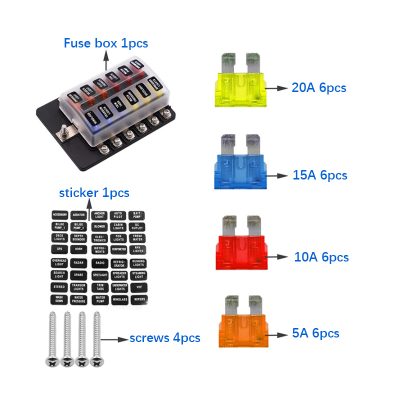
Inline fuse holders typically install inline with wiring harnesses, requiring minimal panel space and basic crimp or solder connections. Their low profile and sealed variants protect against dust and moisture in confined enclosures. Fuse blocks mount on DIN rails or flat surfaces, accommodating multiple circuits in a single module. Block assemblies often include terminal points for easier load balancing and color-coded fuse clips to speed identification. Installation time depends on the number of positions and the complexity of the panel layout.
Performance Advantages in Different Environments
Inline holders excel in applications subject to vibration or limited wiring runs, maintaining reliable contact under motion and stress. Many are rated for automotive, marine, or harsh industrial conditions and include heat-resistant materials. Fuse blocks offer superior thermal dissipation when handling higher current loads across multiple poles. Their modular design allows selective relocation of circuits to minimize shared heating. The centralized block architecture simplifies monitoring and diagnostics when combined with busbar connections or LED fault indicators.
Application Scenarios and Use Cases
Automotive wiring harnesses benefit from inline fuse holders protecting individual accessories such as lighting, audio amplifiers, and power windows. Marine craft use sealed inline units to shield circuits from spray and corrosion. For factory automation, control panels leverage fuse blocks to manage distribution across sensors, actuators, and PLC inputs. Renewable energy systems also use fuse blocks to consolidate multiple string inputs or battery banks into a monitoring hub. The decision aligns with project scale, circuit count, and maintenance schedules.
1、Choosing criteria
Consider spatial constraints, circuit count, service access, and environmental protection requirements.
2、Compatibility in existing setups
It depends on panel configuration, wiring harness design, and load distribution; verify mechanical and electrical compatibility before swapping components.
3、Differences in maintenance routines
Inline holders enable fast fuse replacement in confined areas, while block systems offer centralized access, clearer circuit labeling, and organized troubleshooting.